
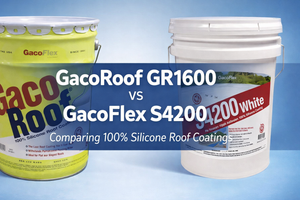
High-Solids vs Low-Solids 100% Silicone Roof Coatings: GacoFlex S4200 vs GacoRoof GR1600
Posted by Hecto de Leon on Jan 12th 2026
When choosing a silicone roof coating, one of the most important factors to understand is solids content. While both high-solids and low-solids 100% silicone roof coatings provide excellent waterproofing and UV protection, they perform differently during application and over the long term.
In this article, we’ll break down the key differences, advantages, and disadvantages of high-solids silicone (GacoFlex S4200) versus low-solids silicone (GacoRoof GR1600) so you can choose the best option for your roof.
What Does “Solids Content” Mean in Silicone Roof Coatings?
Solids content refers to the percentage of coating material that remains on the roof after curing.
• High-solids silicone leaves more material behind, creating a thicker membrane in fewer passes.
• Low-solids silicone contains more solvent, so the cured membrane is thinner per coat and may require additional material to reach the desired thickness.
Both types are still 100% silicone, but their application characteristics and performance differ.
High-Solids 100% Silicone: GacoFlex S4200
Pros of GacoFlex S4200
Thicker Coverage per Coat
High-solids silicone builds film thickness quickly, allowing contractors to achieve required mil thickness with fewer coats.
Excellent Ponding Water Resistance
Like all silicone coatings, S4200 is unaffected by standing water, making it ideal for flat and low-slope roofs.
Long-Term Durability
The thicker cured membrane provides enhanced resistance to weathering, UV exposure, and foot traffic.
Reduced Material Shrinkage
Since more solids remain after curing, there is less volume loss compared to low-solids coatings.
Cons of GacoFlex S4200
More Difficult to Apply
High-solids silicone is thicker and can be harder to spray or roll, especially in cooler temperatures.
Higher Initial Cost
The upfront cost per gallon is typically higher than low-solids silicone.
Requires Experienced Applicators
Because of its viscosity, proper equipment and experience are important for consistent application.
Low-Solids 100% Silicone: GacoRoof GR1600
Pros of GacoRoof GR1600
Easier Application
GR1600 flows more easily, making it simpler to spray, roll, or brush—especially for smaller projects or less experienced installers.
Smoother Finish
The thinner consistency allows for easier leveling and a more uniform appearance.
Lower Initial Cost
Low-solids silicone coatings generally have a lower cost per gallon.
Excellent Waterproofing
Despite lower solids, GR1600 still provides outstanding waterproofing and UV resistance once proper thickness is achieved.
Cons of GacoRoof GR1600
Requires More Material
Because of solvent evaporation, more product is needed to achieve the same dry film thickness as a high-solids coating.
Longer Application Time
Multiple passes may be required to reach manufacturer-recommended mil thickness.
More Shrinkage During Cure
Higher solvent content means more volume loss as the coating cures.
Side-by-Side Comparison
|
Feature |
GacoFlex S4200 (High-Solids) |
GacoRoof GR1600 (Low-Solids) |
|
Solids Content |
High |
Lower |
|
Film Build |
Thick per coat |
Thinner per coat |
|
Application |
More difficult |
Easier |
|
Material Usage |
Less overall |
More overall |
|
Cost per Gallon |
Higher |
Lower |
|
Ponding Water Resistance |
Excellent |
Excellent |
|
Ideal For |
Large commercial roofs, experienced crews |
Smaller projects, ease of application |
Which Silicone Roof Coating Is Right for You?
Choose GacoFlex S4200 if:
• You want maximum durability and thickness
• You’re working on large commercial or industrial roofs
• You have professional application equipment and experience
Choose GacoRoof GR1600 if:
• Ease of application is a priority
• You’re working on smaller projects or maintenance coatings
• Lower upfront material cost is important
Both products deliver the core benefits of 100% silicone roofing—including waterproofing, UV resistance, and long service life. The right choice depends on your roof size, application method, and performance expectations.